
Watchtower
Watchtower tracks when AI companies change their safety policies — and when they break them.

Anthropic updated its Responsible Scaling Policy (RSP) from v3.2 to v3.3.
Anthropic
May 26, 2026
Anthropic updated its Responsible Scaling Policy (RSP) from v3.2 to v3.3. In Section 1, “Our Recommendations for Industry-Wide Safety,” this update included a changed description in the “Capability or usage threshold” for “novel chemical/biological weapons production.” It’s notable that the RSP changelog calls this a “revision,” while the Opus 4.8 system card frames it as a “clarification of the intent of our earlier threshold.” The latter understates the change, given that this is a reshaping rather than a wording tweak. The capability the threshold requires narrowed, from a model that significantly helps threat actors (moderately resourced, expert-backed teams) to one that can substitute for the world-leading specialists such a team would need. However, the harm it covers broadened, from damage “far beyond” COVID-19 to damage “comparable to or worse than” it. The mitigations tied to this threshold remain unchanged.
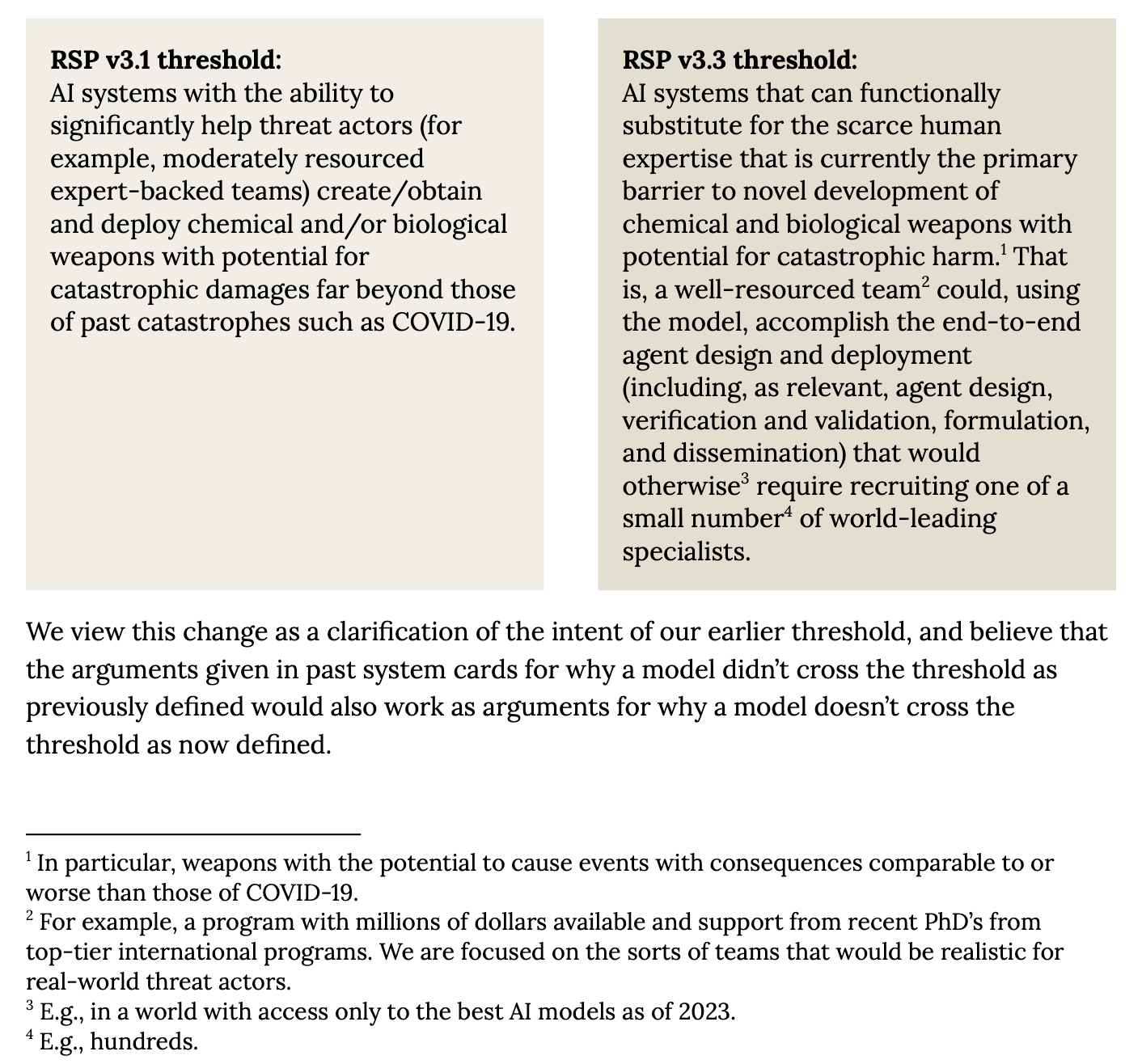
The system card also states that the reasoning used to clear models under the old wording would carry over to the new wording and that the two definitions reach the same conclusion. Anthropic asserts this equivalence rather than demonstrating it; the card doesn't show a model measured against both.
There were also changes to Section 3.1, Risk Reports: Scope and Timing. The criteria for including internally deployed models in a Risk Report are now structured around two explicit conditions: (1) the model could pose risks related to high-stakes misalignment or automated R&D, and (2) those risks significantly exceed those of models covered by a prior Risk Report. Additionally, v3.3 names and refines “off-cycle updates,” analyses that Anthropic publishes between Risk Reports when a model’s risk profile changes significantly.
V3.3 also makes minor terminology changes, notably renaming the third capability-threshold row from “High-stakes sabotage opportunities” to “Misaligned AI systems in high-stakes settings.” The threshold text itself is unchanged.
Correction: This post originally described the chem/bio threshold change as simply making the bar "harder to trigger." That was incomplete. The capability the threshold requires was narrowed, but the harm it covers was broadened, from damage "far beyond" COVID-19 to damage "comparable to or worse than" it. We've also updated the screenshot to include the footnotes where this point is made. Thanks to @MaskedTorah for flagging.

Meta
Oct 12, 2026
Meta publicly launched Muse Wonder with a 13-page model card and without concurrently publishing a safety and preparedness report.
Meta
Oct 2, 2026
Meta updates and renames its safety framework from the "Advanced AI Scaling Framework" (v2) to the "Meta Superintelligence Scaling Framework" (v2.1).
Anthropic
Sep 22, 2026
Anthropic’s release of Opus 5.5 with an “inconclusive” determination for harmful-manipulation.

xAI
Sep 21, 2026
xAI says Grok 4.7 scores below its safety framework’s capability thresholds on dual-use knowledge, but xAI’s safety framework doesn’t provide thresholds.

OpenAI
Sep 9, 2026
Updated the GPT-6 Astra system card, specifically to hedge claims about misalignment.
OpenAI
Aug 18, 2026
OpenAI updated its Model Spec, the document outlining intended model behavior
Frequently asked questions
Have more questions? Our team is happy to help, contact us.