Another AI bill, another suspiciously coordinated influencer campaign
Weeks after a likely astroturfing effort against the AI OVERWATCH Act, the same playbook is targeting Florida's data center bill.
21
min read
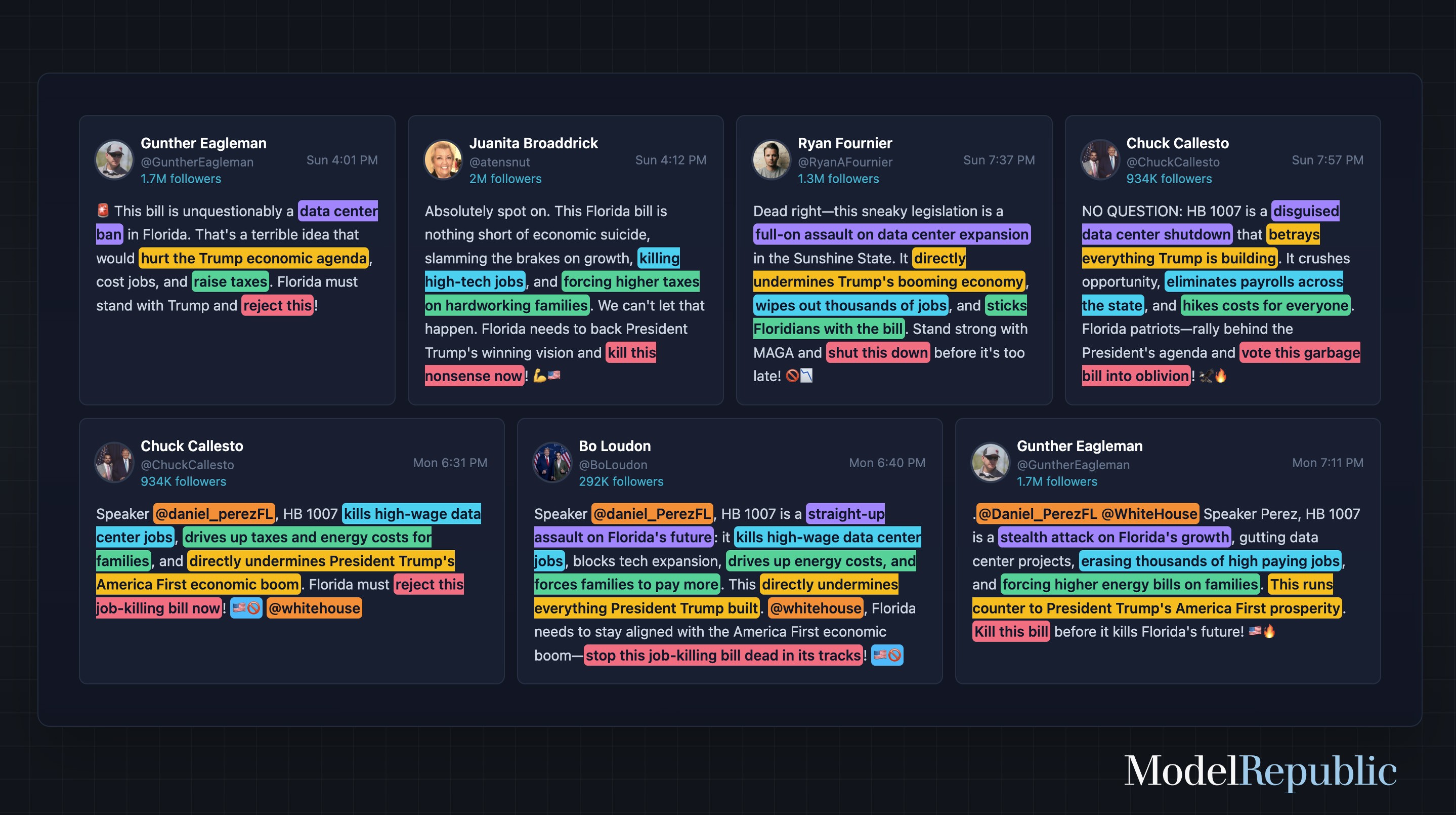

Last month, Model Republic published an investigation into what appeared to be a coordinated influencer campaign against the AI OVERWATCH Act. Over a dozen conservative accounts posted almost identical attacks on the bill within 27 hours of each other, complete with shared talking points and, in two cases, the same typo. The evidence pointed toward a paid political influence operation facilitated by a PR firm, likely Influenceable.
Now it appears to be happening again, this time targeting Florida House Bill 1007, which would regulate large-scale data centers. Starting on Feb. 22nd, a cluster of right-wing influencers began posting remarkably similar criticisms of the bill, coincidentally within another exactly 27-hour window (the same time interval in which the AI OVERWATCH Act campaign took place) and ending the night before a key committee hearing and vote on the bill. Despite the efforts of the influencers, the bill passed its first committee by a strong 24-1 vote, though it still faces two more committee stops before reaching the House floor — and would then need to pass both chambers of the Florida Legislature.
The specifics are documented at the bottom of this article, but the more interesting question is why this keeps happening, and what it tells us about how the AI industry engages with the democratic process.
Data centers are genuinely unpopular with the American public. A Morning Consult poll found that support for a local ban on data center construction grew from 37% to 41% between October and November 2025. A Heatmap survey found that only 44% of Americans would support a data center being built near them, which puts data centers below gas plants, wind farms, and nuclear facilities in public acceptance. According to Data Center Watch, $98 billion worth of data center projects were blocked or delayed in just the second quarter of 2025. This deep unpopularity could explain why some in the industry may have decided to bypass persuading the public entirely, and instead manufacture the appearance of grassroots support.
The funding behind these campaigns remains unclear, but the AI industry is the obvious beneficiary. Data centers are the physical infrastructure of the AI boom, and companies like Nvidia supply the chips that power them. In the case of the AI OVERWATCH campaign, the clearest beneficiary was Nvidia, which had been lobbying against export controls and publicly opposed the bill in question. They are a likely suspect here, too, since their chips are the most expensive input for new AI data centers, although many other parties also have a stake (from hyperscalers to utility companies to data center operators).
But who is actually conducting these campaigns? Is there a firm that takes the AI industry’s money and converts it into astroturfed opposition?
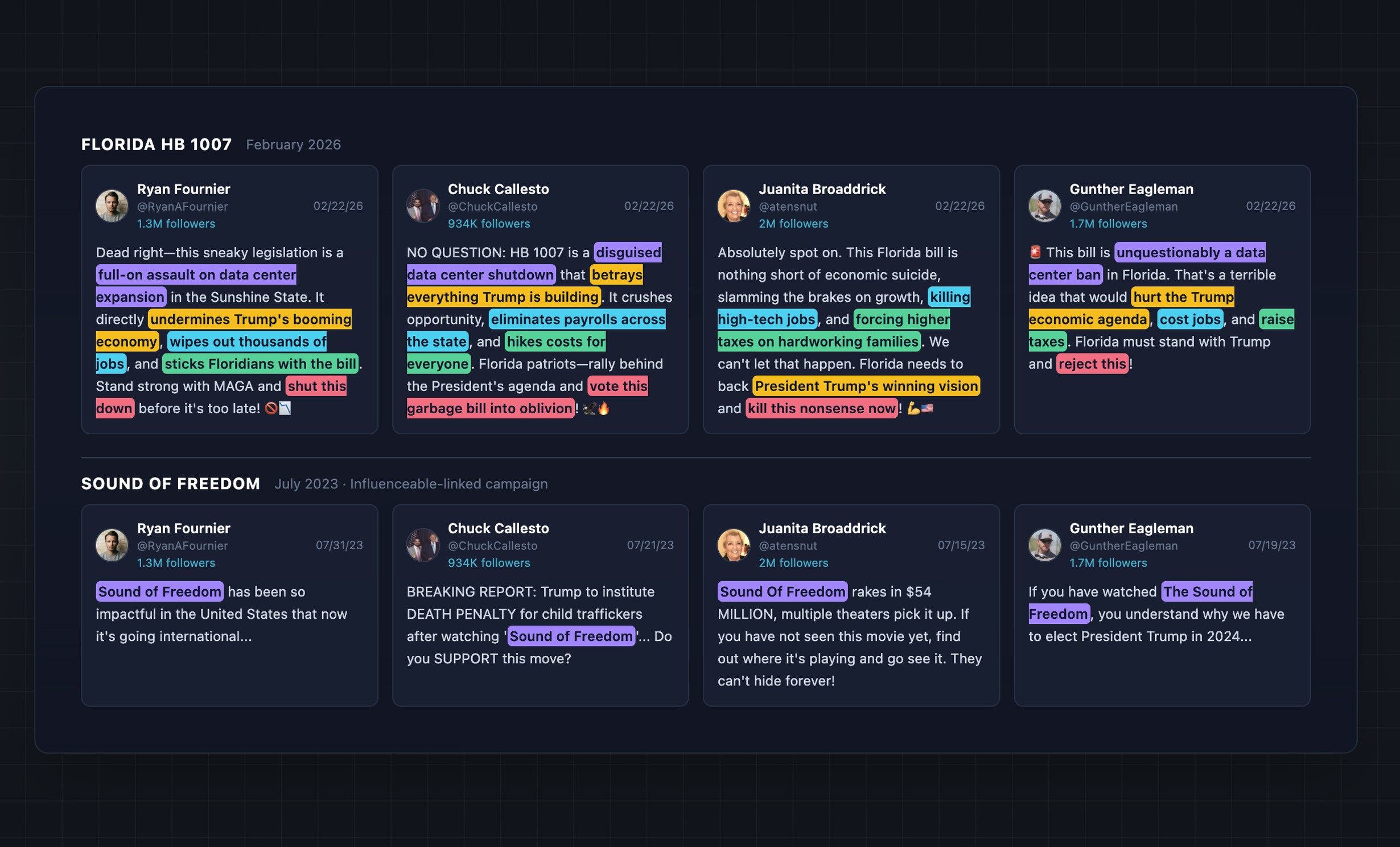
As with the AI OVERWATCH campaign, the most likely suspect appears to be Influenceable. Four of the accounts now attacking Florida’s HB 1007 also promoted the film "Sound of Freedom" in July 2023, a campaign that was run by Influenceable and is currently even advertised on their website. Ryan Fournier, one of the accounts that participated in the most recent Florida campaign, also defended Ken Paxton (a campaign Influenceable was likely paid to orchestrate), promoted other Influenceable-backed films, and participated in the campaign against the AI OVERWATCH Act. That the same people have suddenly developed strong opinions about Florida data center regulation is, at minimum, a striking coincidence.
After publishing our last investigation of Influenceable, The Midas Project discovered that one of the participants in the AI OVERWATCH campaign, Gentry Gevers, was himself a recruiter for Influenceable. However, it’s still not a smoking gun; there is likely a fair amount of overlap in the pay-for-post influencer ecosystem, and it is possible that the same accounts that have worked with Influenceable may work with other firms or participate in coordinated campaigns without pay.
There is something troubling about an industry funding covert campaigns to kill legislation before most people even know it exists. When a company buys a television ad opposing a bill, the ad is legally required to say who paid for it. When a super PAC runs political ads, it files its expenditures with the FEC. These disclosure requirements exist because voters have a right to know who is trying to persuade them. Social media has no equivalent norm. A paid influencer post looks exactly like an organic opinion, with no asterisks and no "sponsored by" disclaimers, leaving audiences with no way to tell the difference between genuine belief and a line item on someone's lobbying budget.
This gap in our disclosure laws mattered less when influencers were hawking protein powder and mobile apps. It matters a great deal more when they are pushing policy positions on behalf of trillion-dollar industries on questions that will shape the economy and society for decades. How AI develops, who benefits from it, who bears its costs and how it gets regulated are among the most consequential political questions of our time. The public deserves an honest conversation about these issues, one where people can tell the difference between authentic voices and paid ones, and where arguments succeed or fail on their merits rather than on the size of someone's promotional budget.
The tweets in question
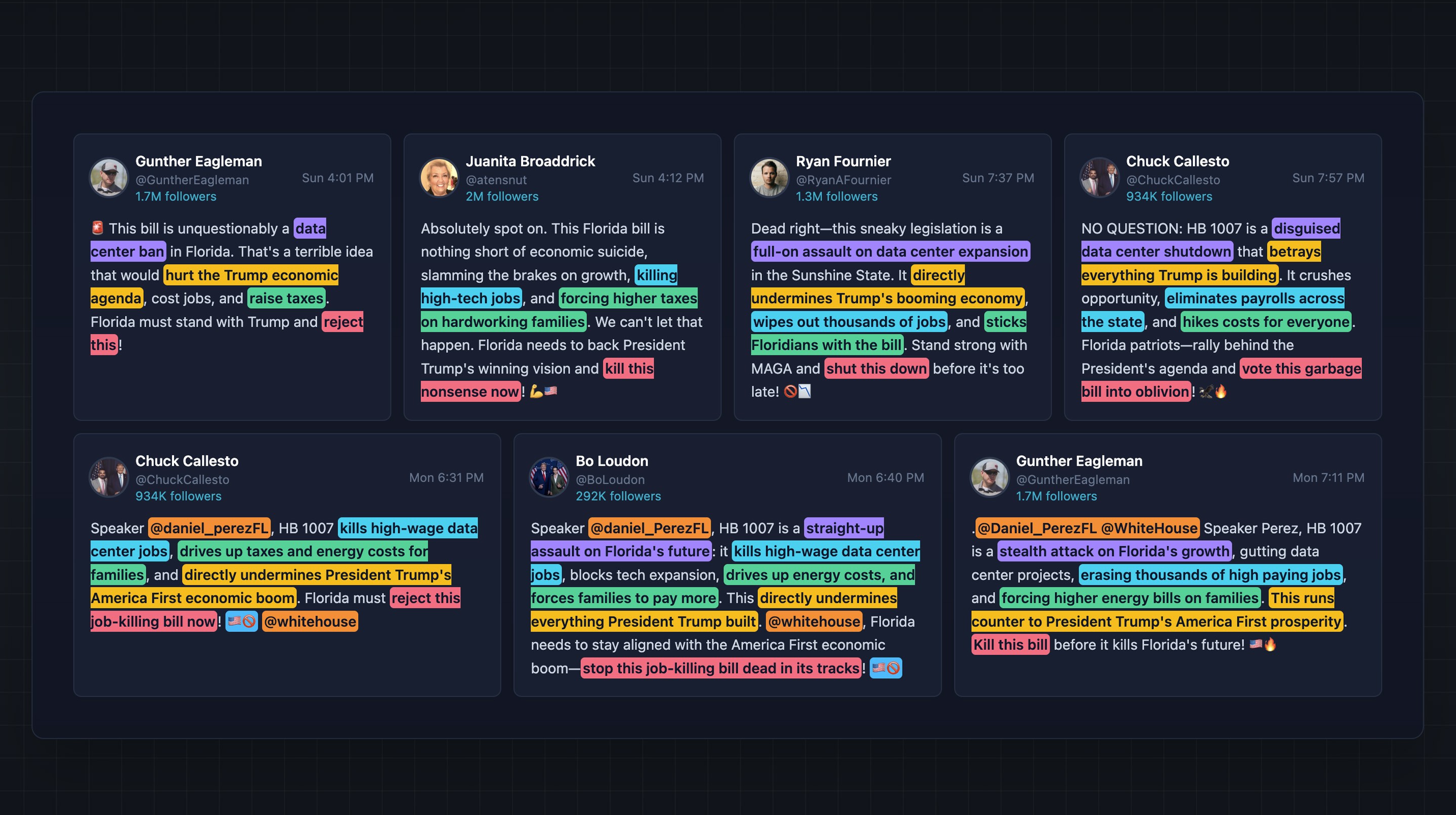
Gunther Eagleman (@GuntherEagleman, 1.7M followers, Sun 4:01 PM ET)
🚨 This bill is unquestionably a data center ban in Florida. That's a terrible idea that would hurt the Trump economic agenda, cost jobs, and raise taxes. Florida must stand with Trump and reject this!
Juanita Broaddrick (@atensnut, 2M followers, Sun 4:12 PM ET)
Absolutely spot on. This Florida bill is nothing short of economic suicide, slamming the brakes on growth, killing high-tech jobs, and forcing higher taxes on hardworking families. We can't let that happen. Florida needs to back President Trump's winning vision and kill this nonsense now! 💪🇺🇸
Ryan Fournier (@RyanAFournier, 1.3M followers, Sun 7:37 PM ET)
Dead right—this sneaky legislation is a full-on assault on data center expansion in the Sunshine State. It directly undermines Trump's booming economy, wipes out thousands of jobs, and sticks Floridians with the bill. Stand strong with MAGA and shut this down before it's too late! 🚫📉
Chuck Callesto (@ChuckCallesto, 934K followers, Sun 7:57 PM ET)
NO QUESTION: HB 1007 is a disguised data center shutdown that betrays everything Trump is building. It crushes opportunity, eliminates payrolls across the state, and hikes costs for everyone. Florida patriots—rally behind the President's agenda and vote this garbage bill into oblivion! 🦅🔥
Chuck Callesto (@ChuckCallesto, 934K followers, Mon 6:31 PM ET)
Speaker @daniel_perezFL, HB 1007 kills high-wage data center jobs, drives up taxes and energy costs for families, and directly undermines President Trump's America First economic boom. Florida must reject this job-killing bill now! 🇺🇸🚫 @whitehouse
Bo Loudon (@BoLoudon, 292K followers, Mon 6:40 PM ET)
Speaker @daniel_PerezFL, HB 1007 is a straight-up assault on Florida's future: it kills high-wage data center jobs, blocks tech expansion, drives up energy costs, and forces families to pay more. This directly undermines everything President Trump built. @whitehouse, Florida needs to stay aligned with the America First economic boom—stop this job-killing bill dead in its tracks! 🇺🇸🚫
Gunther Eagleman (@GuntherEagleman, 1.7M followers, Mon 7:11 PM ET)
.@Daniel_PerezFL @WhiteHouse Speaker Perez, HB 1007 is a stealth attack on Florida's growth, gutting data center projects, erasing thousands of high paying jobs, and forcing higher energy bills on families. This runs counter to President Trump's America First prosperity. Kill this bill before it kills Florida's future! 🇺🇸🔥
As with the AI OVERWATCH campaign, there are clear parallels in the language that these accounts use:
- All seven tweets warned about higher taxes, costs, or energy bills for families
- All seven tweets included forceful calls to action like "reject this," "shut this down," or "kill this bill"
- Six tweets used language like "kills," "wipes out," "eliminates," or "erases" in reference to jobs
- Six tweets said the bill "undermines," "betrays," or "hurts," or otherwise goes against Trump's agenda
- Five tweets called the bill a "ban," "shutdown," or "assault," or “attack” on data centers
- Three tweets tagged both @daniel_perezFL and @whitehouse
- Two accounts posted nearly identical messages with the same structure and closing emojis (🇺🇸🚫)
Four of these accounts have documented ties to Influenceable, a PR firm that pays conservative influencers to post coordinated content without disclosure, and which we speculated was behind the AI OVERWATCH campaign:
- @RyanAFournier (Ryan Fournier): Defended Ken Paxton during Influenceable's campaign in 2023. Promoted "Sound of Freedom" in July 2023, along with other Influenceable-linked films.
- @ChuckCallesto (Chuck Callesto): Posted repeatedly about "Sound of Freedom" in July 2023, including promoting a Trump screening at Bedminster.
- @atensnut (Juanita Broaddrick): Posted multiple times about "Sound of Freedom" in July 2023, including live-tweeting from a theater.
- @GuntherEagleman (Gunther Eagleman): Participated in the "Sound of Freedom" campaign in July 2023.
Research, updates, and insights from the frontlines of AI accountability.
We lead strategic initiatives to monitor tech companies, counter corporate propaganda.
Who is behind the AI safety backlash?
OpenAI wrote a safety framework for California. Its system cards are ignoring it.
Meta's policy on securing model weights is embarrassingly weak.

The Midas Project Joins Coalition Warning about xAI’s Track Record in light of SpaceX’s IPO
The Midas Project, alongside a coalition including Encode, Legal Advocates for Safe Science and Technology, and Guidelight AI Standards, released "xAI: The Unpriced Risk in SpaceX's IPO."
Frequently asked questions
Have more questions? Our team is happy to help, contact us.