Anthropic wrote a weaker second safety policy to comply with California law
Just before SB 53 took effect, Anthropic significantly watered down its obligations with a last-minute change.


Analysis originally shared on Twitter/X
We released an analysis of Anthropic's recent, quiet change to their Frontier Compliance Framework.
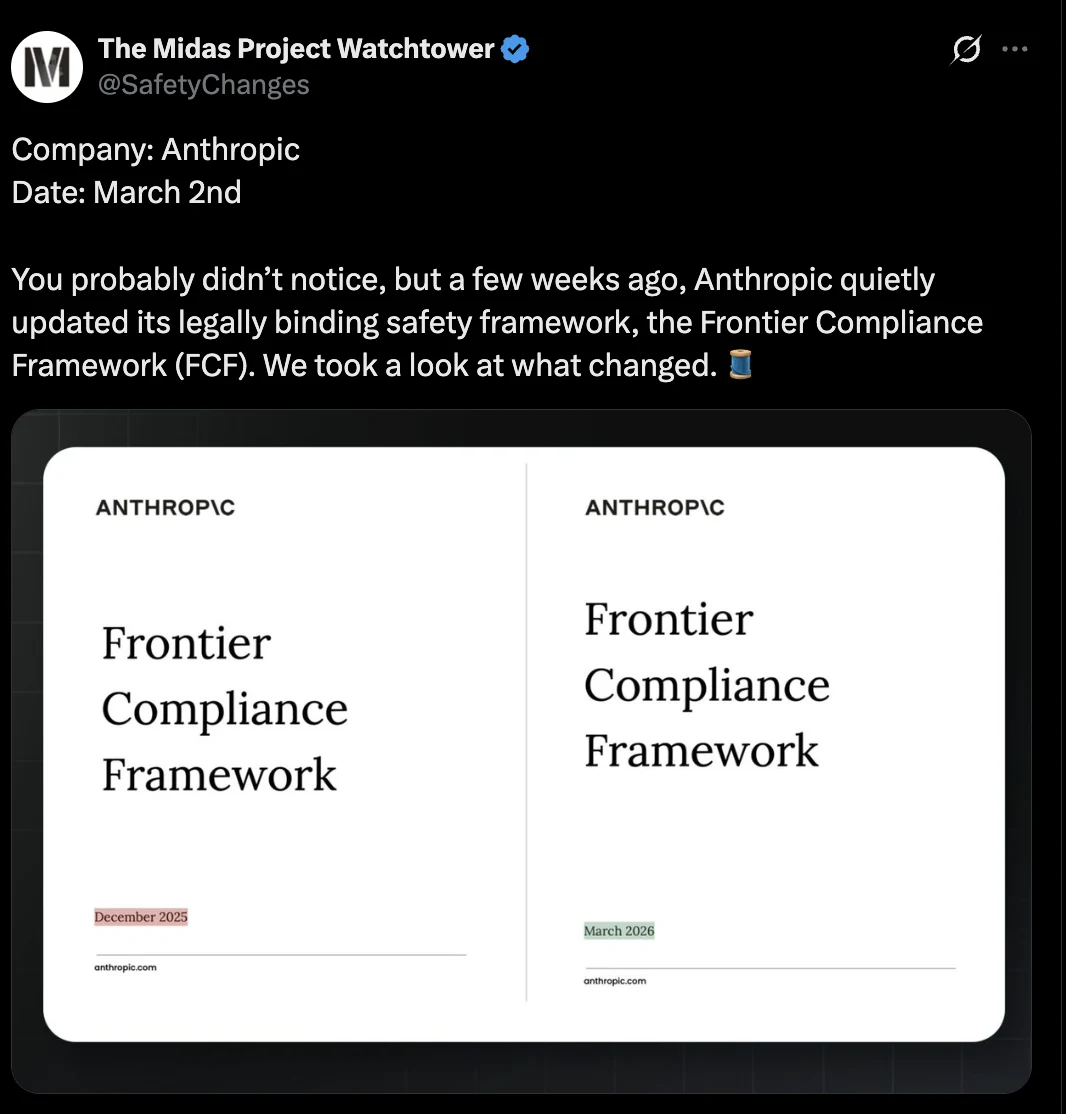
But a more interesting story (which many missed) is the fact that this policy exists at all — and how it minimizes liability for the company.
In 2023, Anthropic worked with METR to adopt the first Responsible Scaling Policy (RSP).
The RSP was a set of "if-then" commitments (if a model hits capability X, implement safeguard Y, or pause). It was the most rigorous commitment any frontier AI lab had made at the time.
Over time, other companies adopted similar policies, and by 2025, this standard was put into law: California's newly passed SB 53 required frontier AI developers to publish and follow safety frameworks like RSPs.
Anthropic endorsed the bill, suggesting it would hold all companies to the standard of Anthropic's RSP. In the past, they have discussed the RSP as a prototype for regulation (even as the substance of their policy has changed).


You'd think they'd be excited to have succeeded in codifying the RSP model. But, just before SB 53 took effect, Anthropic significantly watered down its obligations with a last-minute change.
They released a second (and largely weaker + more vague) document that would substitute for the RSP for compliance purposes, the Frontier Compliance Framework (FCF). By doing so, they ensured that all the promises within the RSP weren't rendered enforceable by SB 53.
The FCF is like the RSP if you tore out much of its substance. It drops the RSP's if-then structure by attaching no specific, binding mitigations to its risk tiers. The text simply states that mitigations "may be determined when the relevant risk tier is reached."
This if-then structure was the core strength of the original RSP, and now it is gone (and not only from the FCF, but also from the RSP itself insofar as they have revoked their commitment to always follow the voluntary RSP).
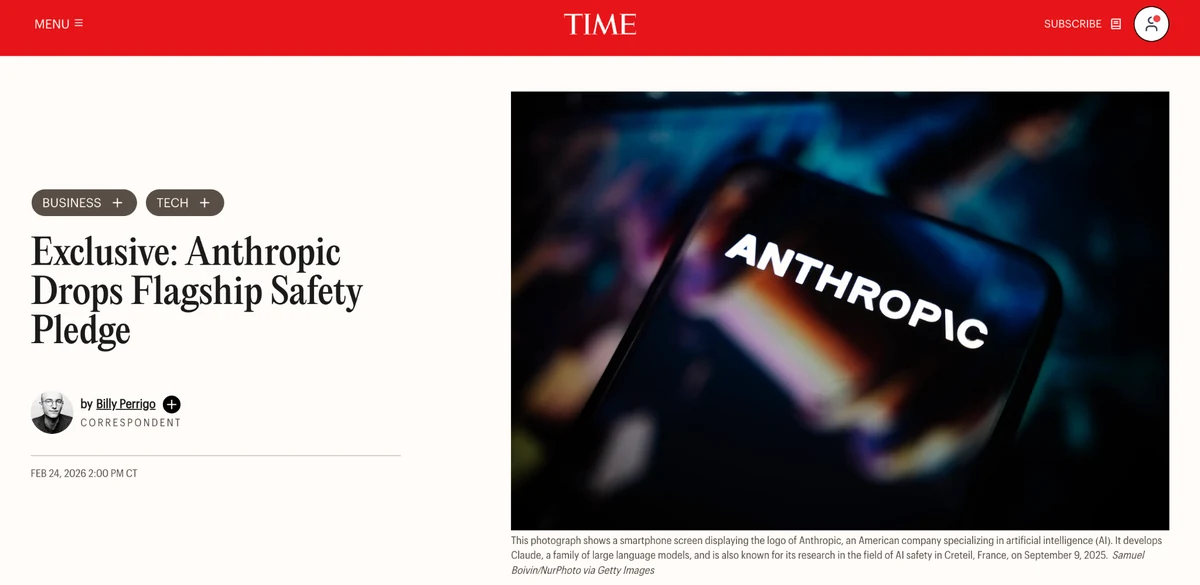
The new FCF also strips out key governance mechanisms found in the RSP.
It removes the detailed Capability and Safeguard Reports and eliminates the formal oversight role previously held by the Long-Term Benefit Trust regarding model deployment decisions. The result is a dual-track system with a voluntary RSP containing detailed commitments yet imposing no liability, alongside a vague and discretionary policy that absorbs all the liability.
This sets a grim precedent. So far, no other companies have created a separate (weaker) policy for compliance purposes, but seeing Anthropic's example, they might soon. If the most safety-conscious lab treats binding legislation as an exercise in minimizing liability rather than an opportunity to codify best practices, the "race to the top" they were hoping for collapses.
When updating the RSP to its largely-weaker v3.0 last month, Jared Kaplan told TIME "We didn't really feel, with the rapid advance of AI, that it made sense for us to make unilateral commitments ... if competitors are blazing ahead." So long as this race continues, we should expect continued weakening of standards + companies taking every opportunity they can to minimize liability.
Research, updates, and insights from the frontlines of AI accountability.
We lead strategic initiatives to monitor tech companies, counter corporate propaganda.
Who paid right-wing influencers to promote Nvidia chip sales to China?
Hundreds of fake accounts defended Jensen Huang and attacked lawmakers over chip exports.
It has been a month. Where’s Muse Wonder’s safety report?
The Midas Project Joins Coalition Warning about xAI’s Track Record in light of SpaceX’s IPO
The Midas Project, alongside a coalition including Encode, Legal Advocates for Safe Science and Technology, and Guidelight AI Standards, released "xAI: The Unpriced Risk in SpaceX's IPO."
Frequently asked questions
Have more questions? Our team is happy to help, contact us.
We engage in a combination of research, outreach, and public advocacy to ensure that AI companies are meeting public expectations, and living up to their past promises, when it comes to ensuring responsible AI development and deployment.
The most important component of our work is helping to identify and disseminate industry best practices for AI development. We review technical literature, regulatory guidance, and case studies to distill concrete measures—such as frontier-model risk assessments, red-teaming requirements, audit regimes, and whistle-blower protections—and advocate for the most important voluntary steps that companies can take today to ensure they are acting responsible.
We also monitor whether companies follow their stated policies and industry norms. When evidence shows back-tracking or inadequate controls, we document these gaps and publicly press for corrective action—mobilizing employees, customers, and civil-society allies until the company adopts the necessary safeguards.
Finally, we publicize our research to help ensure the public is aware of how AI developers stack up on safety and responsibility. We release concise scorecards, incident analyses, and memos so that regulators, investors, and the wider public can see how individual developers perform on safety and responsibility.
Various AI experts including Nick Bostrom and Stuart Russell have compared the development of advanced AI to the myth of King Midas.
According to the legend, King Midas once asked a powerful satyr to make it so that whatever he touched instantly turned into gold. At first, he was thrilled with his new powers. But the King soon discovered that he couldn’t touch food, water, or even his family without instantly turning them to metal. In other words, the sudden attainment of an incredible power with insufficiently well-specified goals and safeguards led to a terrible tragedy.
Much like King Midas, tech companies are now eagerly pursuing incredible wealth and power by developing artificial intelligence, a technology that will change our world forever. But how will we know that it is designed in alignment with our collective human values? If we misspecify even a single goal or safeguard for these systems, how will we prevent them from causing an incredible catastrophe?
In the words of Stuart Russell, “If you continue on the current path, the better AI gets, the worse things get for us. For any given incorrectly stated objective, the better a system achieves that objective, the worse it is.”
The Midas Project is a nonprofit organization founded in early 2024 by Tyler Johnston. Our work is supported by a small core team and a wider base of volunteers and supporters. We are a nonprofit, tax-exempt, 501(c)(3) organization that relies on donations from the public.
No. One of our central values is a pro-technology attitude.
Progress in technology has improved lives for millions of people around the globe (after all, without it, we wouldn’t have penicillin, air conditioning, or the internet). Artificial intelligence is already being used by millions to help improve medicine, education, and overall living standards. We believe this progress should continue, and we hope AI will be a positive force in the world.
However, we are also realists — and skeptical realists at that. We believe advanced AI systems may be a “dual-use” technology that can be used for harm as well. In order to avert social inequality, concentration of power, or AI-driven catastrophes, everybody needs to have a voice at the table when decisions about development and deployment are being made.
Currently, the vast majority of these decisions about the future of AI are being made in shadowy corporate boardrooms with little oversight and accountability. That’s why The Midas Project is committed to raising awareness about the risks of AI, and ensuring that global citizens are given a chance to make their voice heard.
If you’d like to get involved, consider signing up for our newsletter, joining as an official volunteer, or making a charitable donation today.
You can email us at info@themidasproject.com, or reach out via the form on our contact page.