Joint letter requests transparency from OpenAI about its restructuring
A coalition of over 100 Nobel Prize winners, professors, whistleblowers, and public figures have released an open letter calling on OpenAI to answer 7 questions.

A coalition of over 100 Nobel Prize winners, professors, whistleblowers, and public figures has released an open letter calling on OpenAI to be transparent about its controversial restructuring plans.
The letter, co-organized and published by the Midas Project at openai-transparency.org, raises critical questions about whether OpenAI will honor its founding mission to benefit humanity.
From Nonprofit to For-Profit: What's at Stake?
OpenAI was originally founded as a nonprofit with a legally binding commitment to ensure artificial general intelligence (AGI) benefits the public. The organization used this mission to raise money and attract top talent. However, investor pressure has fundamentally changed the company's trajectory.
The signatories argue that OpenAI hasn't been straightforward about this restructuring, describing the removal of profit caps as merely a "simplification" while downplaying the potential disempowerment of the nonprofit board, and saying that their new structure will let them put purpose over profit when it seems the opposite may be true.
The Core Concern: A Deal Made in Secret
The letter begins with: "OpenAI is currently sitting on both sides of the table in a closed boardroom, making a deal on humanity's behalf without allowing us to see the contract, know the terms, or sign off on the decision."
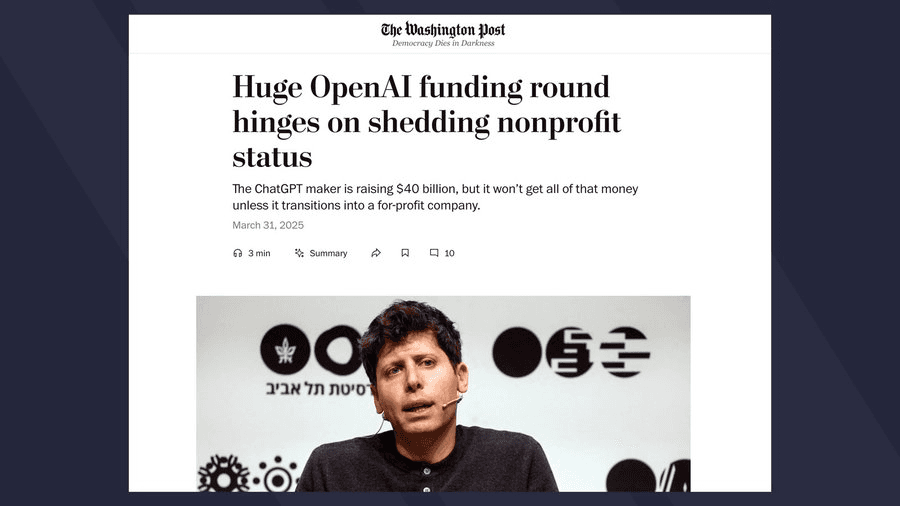
This reflects growing concerns about OpenAI's potential transition from a nonprofit organization to a for-profit company. As reported by The Washington Post, OpenAI's massive $40 billion funding round hinges on shedding its nonprofit status entirely.
Seven Critical Questions Demanding Answers
The open letter poses seven key questions that are critical for the public to understand OpenAI's future direction:
1. Mission vs. Profits
Will OpenAI continue to have a legal duty to prioritize its charitable mission over profits?
By default, public benefit corporations do not legally need to prioritize mission over profit, they only need to balance these concerns.
2. Nonprofit Control
Will OpenAI's nonprofit continue to have full management control over the company?
OpenAI’s comments, including in their letter to California Attorney General Rob Bonta, suggest the nonprofit may retain nominal control while losing substantive powers.
3. Board Equity
Which nonprofit directors will receive equity in OpenAI's new structure?
The current board includes AI investors and entrepreneurs who may benefit financially from the restructuring they're approving. Will they receive equity in a new company?
4. Profit Caps
Will OpenAI maintain its commitment to cap profits and devote excess returns to humanity's benefit?
Leadership previously said the wealth generated by AGI would be "for sure not okay" for a single group of investors to own, and that if they succeed, the “vast majority” of what they earn will be returned to humanity. Is this still true?.
5. AGI Commercialization
Does OpenAI plan to commercialize AGI instead of maintaining nonprofit control?
The company once promised AGI would remain under nonprofit oversight for humanity's benefit, effectively terminating the rights for partners to sell their models at that critical threshold. However, recent reporting suggests they are considering pushing back or scrapping that commitment.
6. Safety Commitments
Will OpenAI honor its charter's pledge to stop competing and assist other organizations if they approach AGI first?
OpenAI’s charter includes a promise that, because an all out race to AGI could pose severe risks, if another company is close to developing the technology, they will stop racing and start assisting to reduce the market pressures and encourage safety. Is this still true?
7. Public Transparency
Will OpenAI release key documents showing what the public stands to lose, including operating agreements and profit estimates shared with investors?
And will the public ever get to see the details of our current entitlements and safeguards as they are legally instantiated in OpenAI documents, or will they continue to be quietly changed without our knowledge (as happened to the profit caps in 2023)?
Distinguished Voices Calling for Accountability
The letter's signatories represent a remarkable cross-section of AI expertise and :
Nobel Laureates:
- Geoffrey Hinton (often called the "godfather of AI")
- Sheldon Lee Glashow (Harvard University)
- Giorgio Parisi (Sapienza University)
- Sir Oliver Hart (Harvard University)
Tech Leaders:
- Vitalik Buterin (Co-founder of Ethereum)
- Multiple former OpenAI affiliates including Daniel Kokotajlo and Helen Toner
- Audrey Tang (Institute for Ethics in AI, Oxford, former Minister of Digital Affairs of Taiwan)
Public Figures:
- Sir Stephen Fry (Writer, Director, Actor)
- Sean Carroll (Johns Hopkins University)
- Rafael Lozano-Hemmer (Antimodular Studio)
Academic Leaders:
- Lawrence Lessig (Harvard Law School)
- Stuart Russell (UC Berkeley, AI Safety expert)
- Max Tegmark (MIT, Future of Life Institute)
The diversity of signatories, spanning Nobel laureates, tech pioneers, legal scholars, and former OpenAI insiders, underscores the broad public concern about OpenAI's direction.
What This Means for the Future of AI
The restructuring has implications far beyond OpenAI itself. As the letter states: "We are all part of humanity, and thus beneficiaries of OpenAI's mission. Everyone has a stake in this restructuring and deserves to know the details."
The fundamental question is whether one of the world's most powerful AI companies will prioritize its stated mission to benefit humanity or succumb to investor pressure for maximum returns. The answer will affect everyone.
The Path Forward
The open letter and its coalition of signers are calling for basic transparency about how the restructuring will affect OpenAI's legal commitments to the public. The ball is now in OpenAI's court.
Will the company that once promised to ensure AGI benefits all of humanity provide the transparency its own mission demands? The answer may determine not just OpenAI's future, but the future of AI governance itself.
We look forward to hearing OpenAI's response.
To read the full letter and add your name to the growing list of signatories, visit openai-transparency.org
Research, updates, and insights from the frontlines of AI accountability.
We lead strategic initiatives to monitor tech companies, counter corporate propaganda.
Who is behind the AI safety backlash?
OpenAI wrote a safety framework for California. Its system cards are ignoring it.
Meta's policy on securing model weights is embarrassingly weak.

The Midas Project Joins Coalition Warning about xAI’s Track Record in light of SpaceX’s IPO
The Midas Project, alongside a coalition including Encode, Legal Advocates for Safe Science and Technology, and Guidelight AI Standards, released "xAI: The Unpriced Risk in SpaceX's IPO."
Frequently asked questions
Have more questions? Our team is happy to help, contact us.