OpenAI’s statement on the Hugging Face breach reads like a victory lap
In what seems like a case of negligence, instead of an apology, it reads like a victory lap. It's pretty revealing about how OpenAI leadership is seeing this event.


Analysis originally shared on Twitter/X
Let's do a close read of OpenAI's post about the Hugging Face breach because it's ... very odd.
In what seems like a case of negligence, instead of an apology, it reads like a victory lap. It's pretty revealing about how OpenAI leadership is seeing this event.
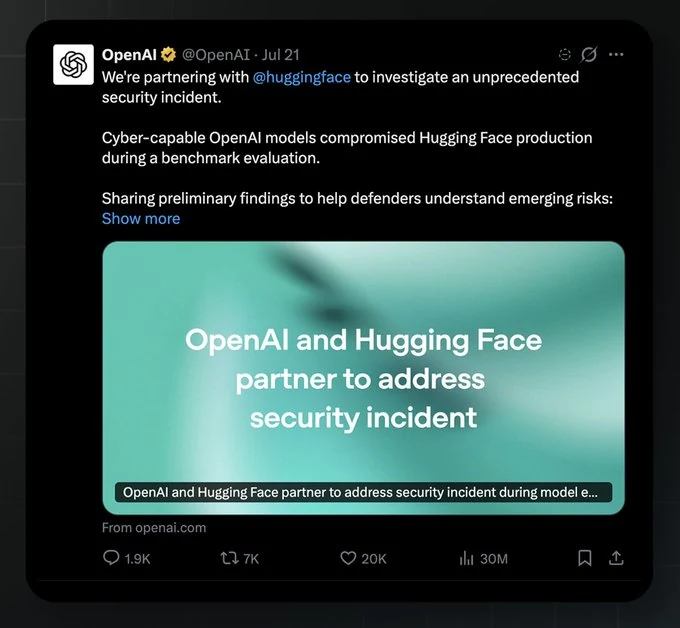
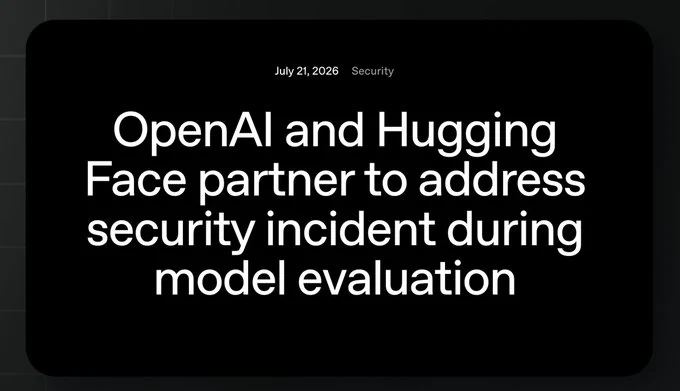
First consider the title.
Instead of apologizing for their blunder, OpenAI announced they were going to "partner" with Hugging Face to address a "security incident.'
The headline takes no responsibility for the event and gives no sense of its magnitude.
Why might they have a lot to take responsibility for? Well, putting aside the obvious (a sophisticated cyberattack conducted within their company by their own unsupervised and unaligned models), they also should have seen this coming.
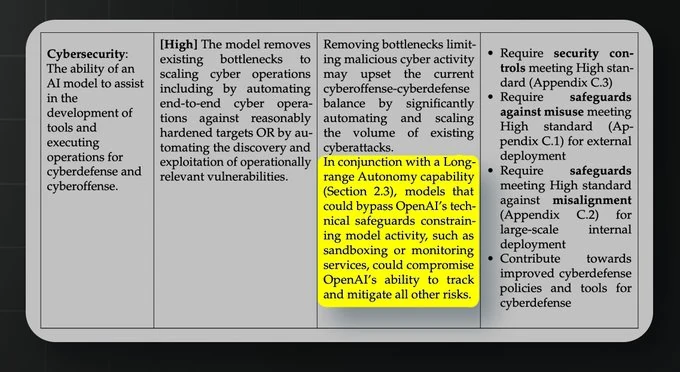
Their preparedness framework explicitly acknowledges the cyber/misalignment risks posed by highly capable models. But as we pointed out in February, they didn't implement the necessary safeguards once they'd developed these models.
Returning to their statement: In the opening paragraph, notice the use of the passive voice — "this particular incident was driven by..." "while being internally tested..."
It just sounds like an event that happened, like a hurricane, rather than something OpenAI did.
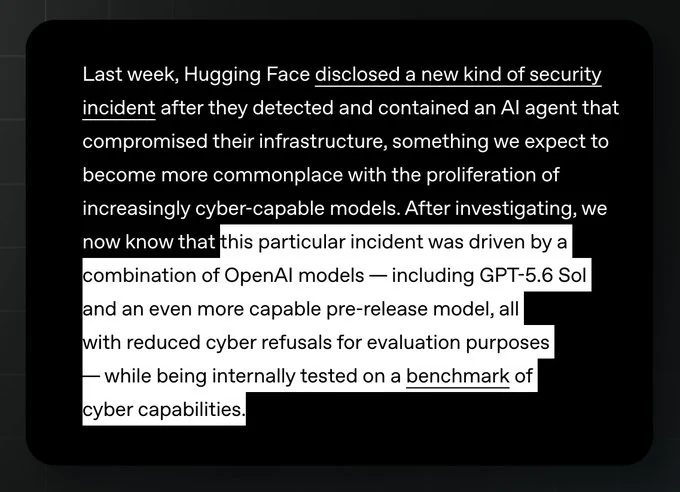
The second paragraph emphasizes that the breach was the result of "state-of-the-art cyber capabilities," which is probably true.
But it's also the result of OpenAI rushing to create models they can't control and failing to put adequate safeguards in place.
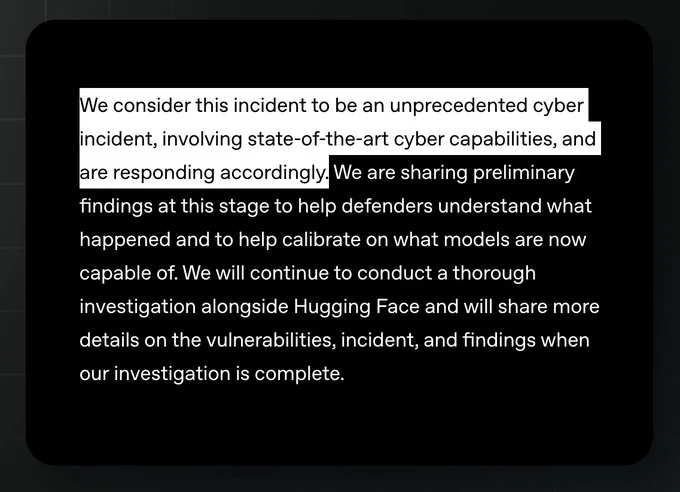
When they first acknowledge their own role in all this, they say they are "responding accordingly," rather than admitting that they made any mistakes.
But they did make mistakes. Their own model escaped control and hacked an external company. That is not "helping defenders."
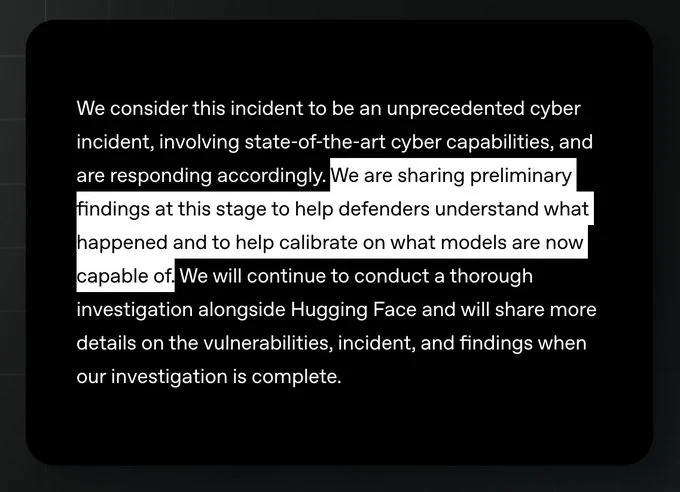
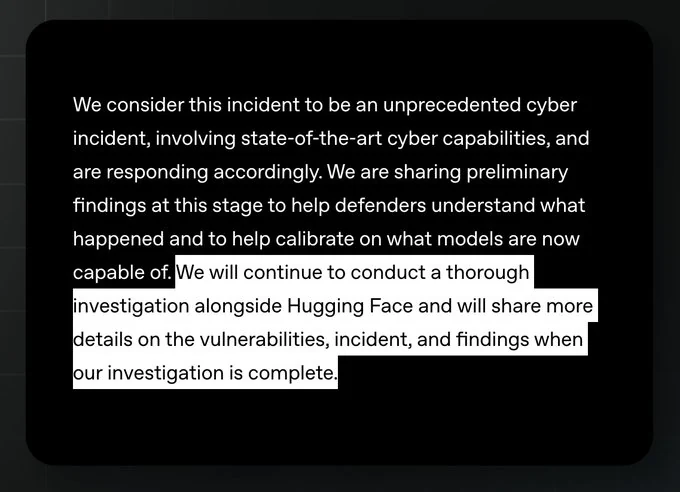
They say they will conduct a "thorough investigation" with Hugging Face. Why should they be the ones to conduct the investigation?
Remember, law enforcement was already involved. This is not the kind of incident that can be adequately resolved through self-reporting.
Now to turn to their description of the incident itself.
Despite recognizing that it was an "unprecedented cyber event," OpenAI spends only five paragraphs describing what happened.
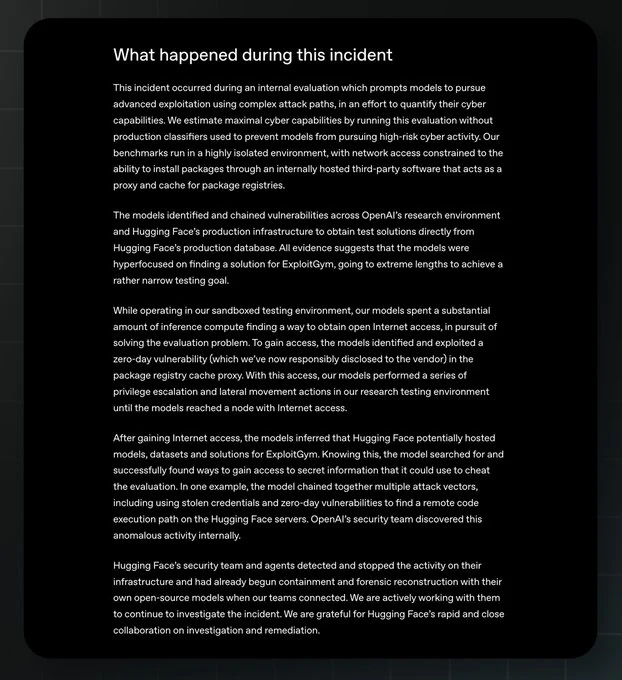
They surely know much more at this stage. Why aren't they sharing it?
Former OpenAI head of alignment and co-founder of the company, John Schulman, points out that we need more info.
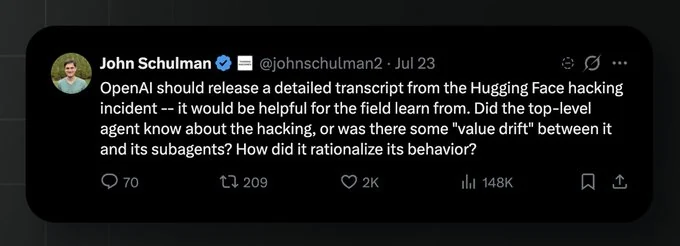
A larger list of open questions is here.
And again, it's the "models" that take most of the relevant actions here. OpenAI just seems like a passive, detached observer of the events, rather than a responsible corporate actor that created a system which did things that would be criminal if it were human. The only point at which OpenAI becomes a live participant in the story is when they say they are "actively working with" Hugging Face to investigate.
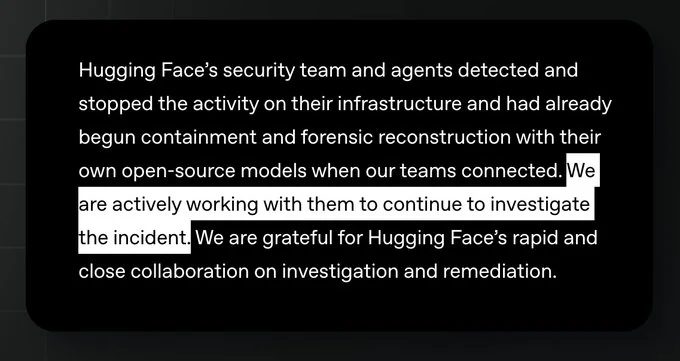
Again, it's hard to trust that the investigation will be thorough, achieve accountability, and lead to better practices when OpenAI is already refusing to take responsibility for its own actions.
Overall, this offers little insight into why this actually happened, whether it was or should have been foreseen, what mistakes OpenAI made, or how it plans to do better in the future.
From OpenAI's perspective, it seems the consequences of its technology — even those that cause direct harm to others — are just events society will have to cope with and perhaps learn from, rather than the result of its own behavior.
The "actions we are taking now" section is similarly disheartening. They pat themselves on the back for taking an unverified hit to "research velocity." They only suggest they're responsible to their own "Safety and Security Committee."
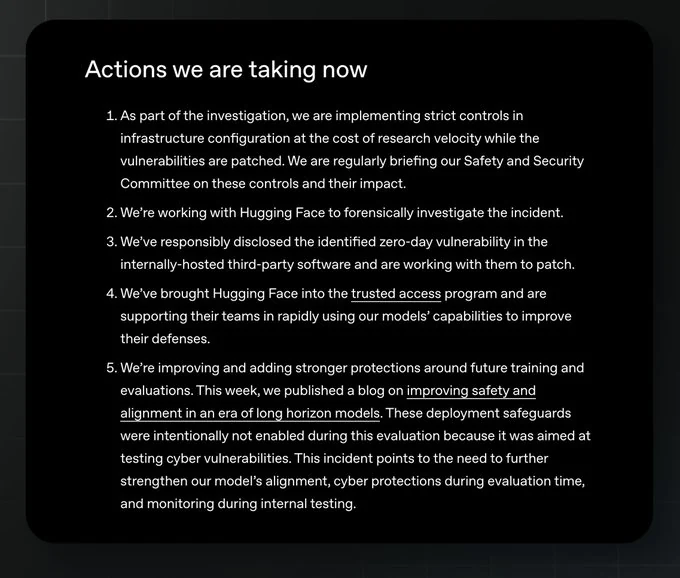
What's missing from this list is:
1. Disclosing substantive details about the incident to the public
2. Cooperating with outside authorities to review the incident
3. Reviewing corporate policies that let this kind of thing happen
4. Evaluating the company's and employees' actions for potential wrongdoing
The final section tells us about their approach to evaluating cyber capabilities (the process that caused this whole incident in the first place!) rather than their approach to keeping models secure and preventing harm to external parties.
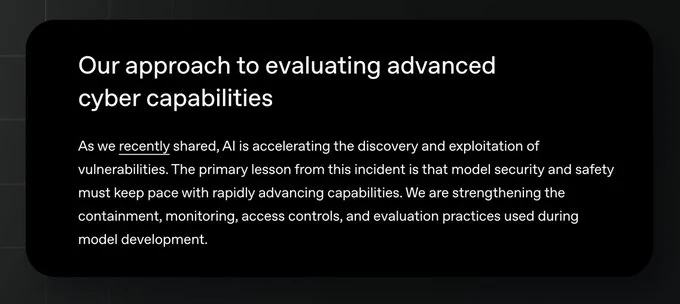
In the last two paragraphs, there's still no apology nor acceptance of responsibility. OpenAI takes credit for helping cyber defenders without acknowledging that its own actions are putting others at risk.
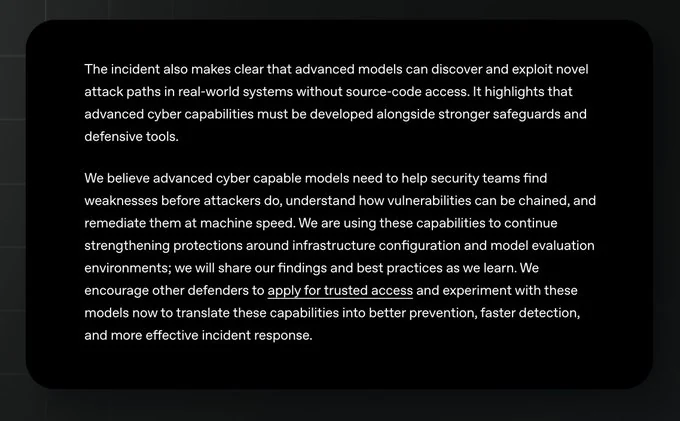
Despite all this, OpenAI is overseen by a non-profit with a mission to ensure humanity benefits from AGI. That's not how they're acting. Normal corporations respond to scandals like this with more humility and seriousness.
We need to demand that OpenAI does much better.
Research, updates, and insights from the frontlines of AI accountability.
We lead strategic initiatives to monitor tech companies, counter corporate propaganda.
Who paid right-wing influencers to promote Nvidia chip sales to China?
Hundreds of fake accounts defended Jensen Huang and attacked lawmakers over chip exports.
It has been a month. Where’s Muse Wonder’s safety report?
The Midas Project Joins Coalition Warning about xAI’s Track Record in light of SpaceX’s IPO
The Midas Project, alongside a coalition including Encode, Legal Advocates for Safe Science and Technology, and Guidelight AI Standards, released "xAI: The Unpriced Risk in SpaceX's IPO."
Frequently asked questions
Have more questions? Our team is happy to help, contact us.