"The OpenAI Files" documents a turbulent decade at Sam Altman's nonprofit-turned-tech-giant
We believe OpenAI still has a narrow window to reclaim its mission. Here's how.

OpenAI began as a nonprofit with an explicit mission to ensure that artificial intelligence benefits all of humanity. But now, only ten years later, it has begun reshaping itself into a $300 billion for-profit enterprise, trading its legal obligation to humanity for the right to generate unlimited investor returns.
This restructuring may mark the culmination of a decade of seismic change at the San Francisco AI developer. Dozens of reports from former employees reveal a consistent pattern of conflict at the research-lab-turned-tech-behemoth: a company whose lofty promises of safe, responsible AI development have repeatedly crumbled under the weight of market forces, and a famously charismatic CEO who, upon closer inspection, seems to embody the same contradictions that define the organization itself.
This restructuring isn't just a bureaucratic formality. It's the final unmasking of a company that can no longer sustain its founding myth, and a natural experiment in what happens when idealism collides with economic forces. The question isn't whether OpenAI's founders had good intentions. The question is whether good intentions can co-exist with $60 billion in venture funding and the gravitational pull of what may prove to be the most profitable technology in history.
We believe OpenAI still has a narrow window to reclaim its mission. Here's how.
Announcing:
The OpenAI Files
The Midas Project and the Tech Oversight Project's newest investigation, The OpenAI Files, is a 14,000 word report revealing how Sam Altman's nonprofit-turned-tech-giant has spent the past decade repeatedly fighting, but seemingly always succumbing to, the profit-driven erosion of its founding ideals.
A History of Red Flags
Our investigation, drawing from hundreds of documented sources and testimonies from over two dozen former employees, shows how OpenAI's upcoming restructuring may be the final act of a decade of conflict, eroding norms, and broken promises, including:
- Efforts to silence criticism through restrictive NDAs and threats to employee equity
- Prioritizing shiny products over safety commitments when they conflicted
- Overhauling the OpenAI board with members with numerous potential conflicts of interest
- Creating a culture of "recklessness and secrecy" that led to the multiple mass exoduses of safety, policy, and governance staff
- Re-appointing a CEO who was fired due to concerns about his integrity
“We can say goodbye to the original version of OpenAI that wanted to be unconstrained by financial obligations … It seems to me the original nonprofit has been disempowered and had its mission reinterpreted to be fully aligned with profit.”
- Jeffrey Wu, former OpenAI employee, 9/26/24
The evidence paints a clear picture: OpenAI has found itself, again and again, choosing commercial interests over its stated mission to benefit humanity.
What the Restructuring Would Change
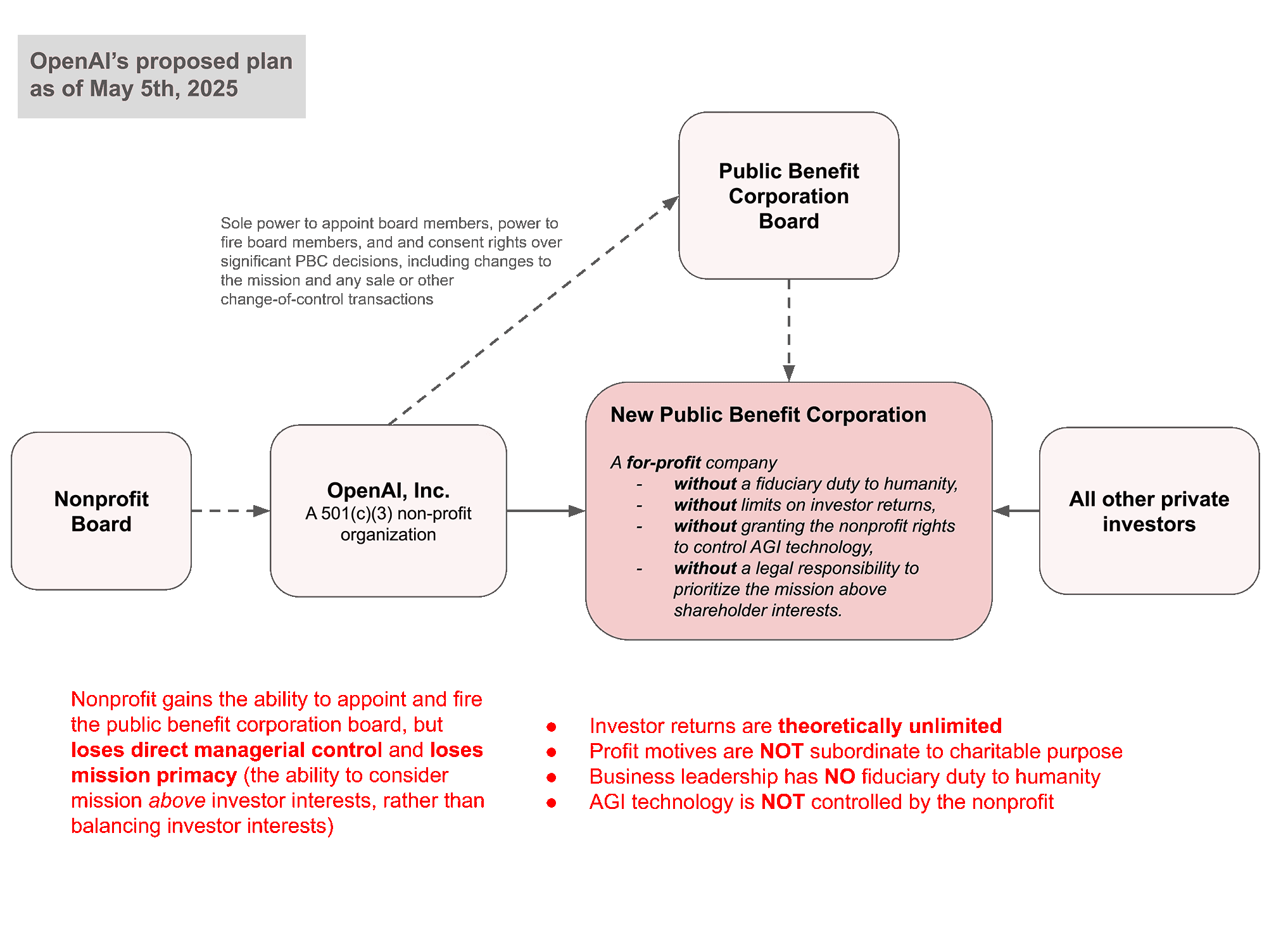
OpenAI's proposed restructuring is a dismantling of the very same safeguards that were once designed to protect the public interest:
Goodbye profit caps. The mechanism ensuring excess value flows back to society instead of private pockets would be eliminated entirely.
Weakened public oversight. The restructuring may transfer managerial control from a nonprofit board whose sole duties are to the public to a for-profit corporation with duties to shareholders.
This isn't the rosy corporate reorganization that OpenAI is trying to sell to you—it's a betrayal of OpenAI's founding principles and legal commitments to humanity. OpenAI once said, "we don’t ever want to be making decisions to benefit shareholders," and that if they succeed, "all but a fraction [of the wealth they generate] is returned to the world." They sure aren't saying that any more.
Why This Matters:
OpenAI's decisions go far beyond simply determining who financially benefits from OpenAI’s technology. OpenAI is developing technology that could fundamentally reshape how we work, communicate, and live our lives. Worse, it could threaten our livelihoods, the stability of our political system, and even the wellbeing of our species. The question of whether this technology primarily serves our interests—and whether there are legal enforcement mechanisms ensuring that—has implications for everyone.
We are all the beneficiaries of OpenAI's current mission, and thus the nonprofit's assets, activities, and powers. We're stakeholders in this decision, and deserve a seat at the table.
What Needs to Happen
The solution is clear: Hold OpenAI to its original promises. That means:
- Maintaining the profit caps that ensure society benefits from AGI development
- Keeping humanity's interests as the legal priority, not shareholder returns
- Implementing robust oversight mechanisms with real enforcement power, not corporate theater
- Elevating leadership standards and resolving conflicts of interest
- Fostering a culture of honest feedback to ensure OpenAI stays aligned with its mission
The full investigation is available at www.openaifiles.org.
The Midas Project and The Tech Oversight Project are independent research organizations focused on corporate accountability and technology oversight.
Research, updates, and insights from the frontlines of AI accountability.
We lead strategic initiatives to monitor tech companies, counter corporate propaganda.
Who is behind the AI safety backlash?
OpenAI wrote a safety framework for California. Its system cards are ignoring it.
Meta's policy on securing model weights is embarrassingly weak.

The Midas Project Joins Coalition Warning about xAI’s Track Record in light of SpaceX’s IPO
The Midas Project, alongside a coalition including Encode, Legal Advocates for Safe Science and Technology, and Guidelight AI Standards, released "xAI: The Unpriced Risk in SpaceX's IPO."
Frequently asked questions
Have more questions? Our team is happy to help, contact us.